
Looking Forward
And round vs. flat yarns

I really enjoy the holidays - the entire season from just before Thanksgiving to New Years. I like gift-giving, baking for others (and ourselves), gift wrapping (when it’s not under pressure), and visits with family and friends.
The last couple months of the year ask a lot of us - physically, emotionally, spiritually, or all of these in various combinations. I try very intentionally to enjoy what this season means and to be in the moment, but a part of me really looks forward to that season right after the holidays. Those moments when we can just hunker down and focus on something we’ve been, perhaps, putting off due to the demands of the holidays.
One thing I am looking forward to is the first Zoom meeting for the Online Rigid Heddle Guild being hosted by Mingo’s Corner Designs on Patreon!
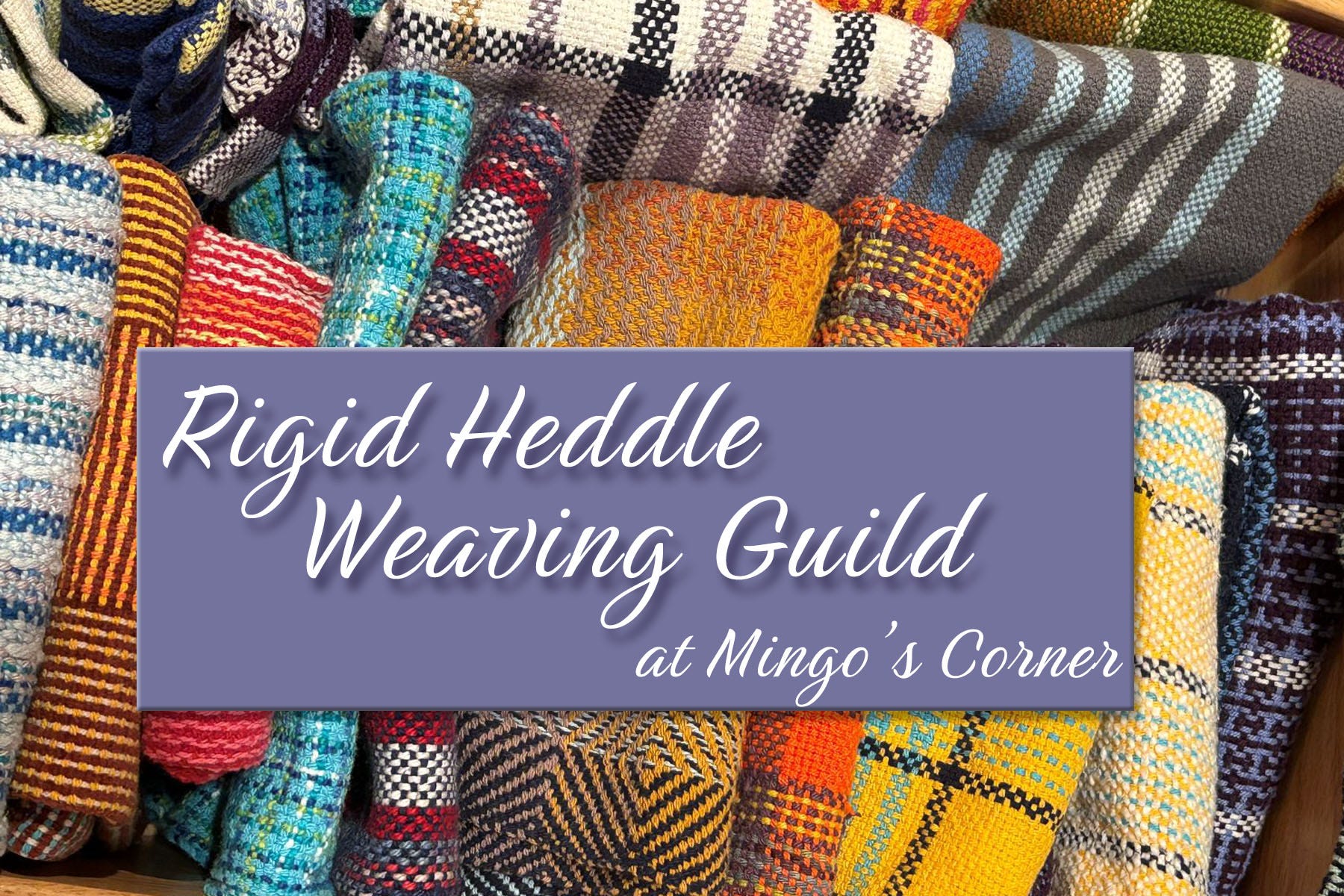
I mentioned this at the end of the last newsletter, but I thought it was time to shout out the news,1 since we are coming up on the first meeting, January 8th, 2026, at 8pm Eastern.
Here are some general points about the Guild - sort of the FAQ’s, if you will:
Meetings will be held, via private Zoom, on the 2nd Thursday of the month, starting at 8:00pm (EST) January 8th, 2026. Zoom links will be emailed out the week-of and the day-of the meeting as a reminder.
Recordings of the guild meetings will be available for members to view for 30 days.
There will be a guild-only chat group on Patreon that will allow for conversations and connections all month between meetings!
Guild memberships are $10 per month. After the group has met Patreon’s establishment guidelines (time and $$ markers), we can have annual subscription options.
Obviously, being in the guild means you will get some early notifications of events and activities, plus I am sure we can dream up some other guild perks, with time!
We can design this guild to be whatever the community needs, but we will keep it rigid heddle focused! Of course, you can be a weaver on other types of looms as well - and sometimes it may be helpful to reference that - but the intent is to celebrate the rigid heddle!
Round versus Flat (Yarns)
A question came up recently on Facebook and I wrote out a response that several folks claimed was very helpful.2 It occurred to me that paraphrasing the conversation here, and perhaps expanding on the response, might be useful.
The question isn’t new - it’s been asked more than once in various FB weaving groups. If 8/4 and doubled 8/2 cottons both have four strands of a size 8 cotton thread in their “bundle” - why would we choose, as many of us so often do, to double the 8/2 rather than just use a single strand of 8/4?
Before I weigh in, let’s be sure we all understand the numbers here. Cotton has a standard gauge assigned to the thickness of strands of cotton, which also includes how much yardage you get for that size strand from a pound of cotton.3 The second number in the North American fraction4 indicates the number of plies the yarn has of that gauge of yarn. So an 8/2 yarn has two plies of a size 8-gauge strand; a 20/3 has three plies of a 20-gauge strand. The higher the first number, the smaller the strands being plied together.5
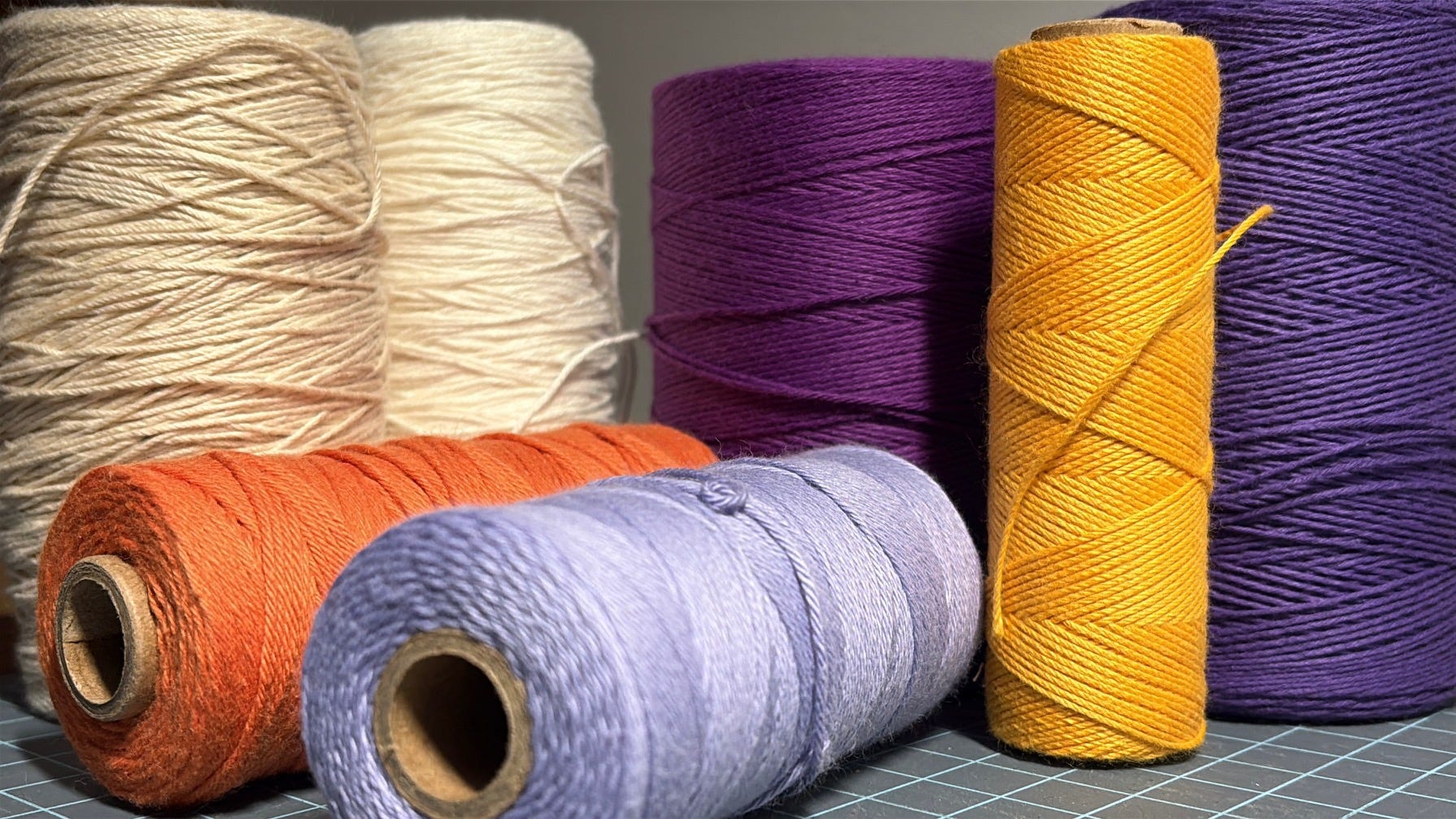
It then becomes a question of mathematics on two levels - yarn grist and yardages - and physics. Two strands of 8/2 will have four plies of a size 8 gauge yarn and those four plies will be the same diameter and grist as the four plies in an 8/4 yarn. Mathematically, that works. In addition, an 8/4 yarn will use half of the yardage of a doubled 8/2 yarn - because you use the 8/4 yarn as a single, the 8/2 as doubled. A lot of folks like this aspect of the maths - half the yarn to make the same towel is very economical!
However, definitions and physics are going to come into play. First, there is the “same towel” idea. Weavers who have worked with both 8/4 and doubled 8/2 usually have a preference that is more subjective than the maths.
One aspect is the feel of the finished cloth. Not all 8/4 yarns are created equal and the most readily acquired 8/4 yarn is probably cotton rug warp. Now, rug warp is exactly what it sounds like - a smooth, strong cotton yarn intended for the warp in weaving rugs. It isn’t unappealing for other uses, but it tends to be best as what it was designed for - strong warp for rugs. However an 8/2 cotton is manufactured, its lighter weight is automatically going to give it more drape and a softer feel than its rug warp companion.
All 8/4 cottons aren’t rug warp, or perhaps even rug-warp-worthy! There are some lovely, softer, 8/4 cottons out there. They tend to be less tightly plied and perhaps even less tightly spun as singles (though that can be difficult to determine with the naked eye.)6 It is definitely worth your time to explore these alternative 8/4 yarns, particularly Cotton Tail and Cloud Nine, both of which I have used and enjoyed.
Folks who love the doubled 8/2 usually talk about drape, the fabric’s “hand”7, and how they feel that the 8/2 towels are softer, more absorbent, etc. Folks who love the 8/4 like its ease-of-use (no doubling), its (often) more vibrant color (because more plies of a color together makes them look more cohesive and, thus, stronger as a color), and the economics of not having to use twice the yardage for a project.
Being in the camp of doubling the 8/2, I would also add that some projects are MUCH easier to thread using doubled 8/2 than single 8/4. Log cabin comes to mind - I would much rather direct warp *and* thread log cabin using doubled 8/2. Using 8/4 is going to require a lot of thinking as you plot where those ends are going to get threaded while you warp (or a lot of tying-off at both ends if you want to warp and thread at the same time.)8
So what’s the catch?
If the debate centers around subjective ideas like how the fabric feels, absorbency, etc., then is there any *real* reason not to substitute single-strand 8/4 for doubled 8/2?
Ah, but we haven’t discussed physics yet! This is fun physics, or at least pre-school level physics, which is fun, right?9
Let’s scale up the size of our yarns for just a bit. And instead of working with multiple strands, let’s just make a substitution. If there are four strands of gauge 8 cotton yarn in both 8/4 AND doubled 8/2, then the substitution has to work to represent both.
We are going to mentally weave with drinking straws.10 Thin plastic (or paper, doesn’t matter) tubes, about 8” long. Those drinking straws.
So to make the comparison, start mentally weaving with the drinking straw tubes. The first thing that I think of is that they are going to have to “give” somehow, to make the bends to go over and under. They are going to be stiff, because round shapes are usually not prone to bending. Finally, the round nature means they want to slip slide around a bit. They roll - because they are round!
Now, flatten some straws. Suddenly, our straws have become more like ribbon. The flattened shape lends itself to bending over and under. The bending might not be silky smooth, but it’s far easier to bend the flat straw than the round one. Because they are flat they are less likely to shift within the weave easily.
The materials in both “samples” are the same. They weigh the same, are made of the same materials, but they are *shaped* differently, because we flattened some of them.
The round straws are 8/4 yarns; the flattened straws are doulbed 8/2 . Same weight, fiber, physical descriptions, but they behave differently when woven because they are different “shapes.”
So, what does this mean?
Well, in plain weave, it might not mean much. If you are looking for texture, or a simple weave with basic striping, 8/4 and doubled 8/2 comes down to the subjective features. Even the “softer” 8/4 yarns worked in plain weave are going to feel slightly different, but that doesn’t make them better or worse, just different.
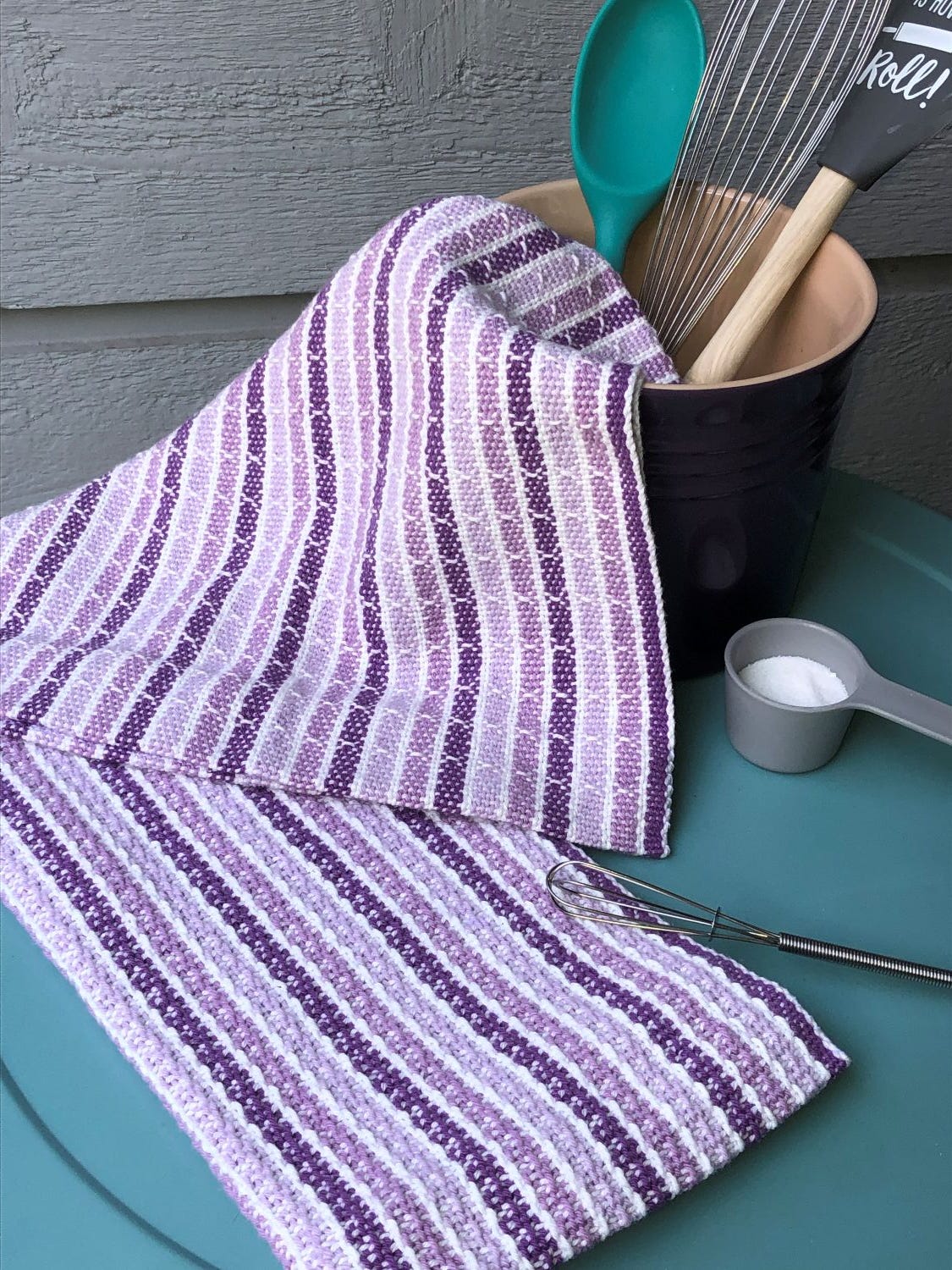
When you go beyond plain weave, working with color-and-weave and finer design elements there, or into twills, that’s when the “flat straw” and “round straw” shape difference matters. Because the round straws have a tendency to roll out of place, and take up a bit more space than you expect!
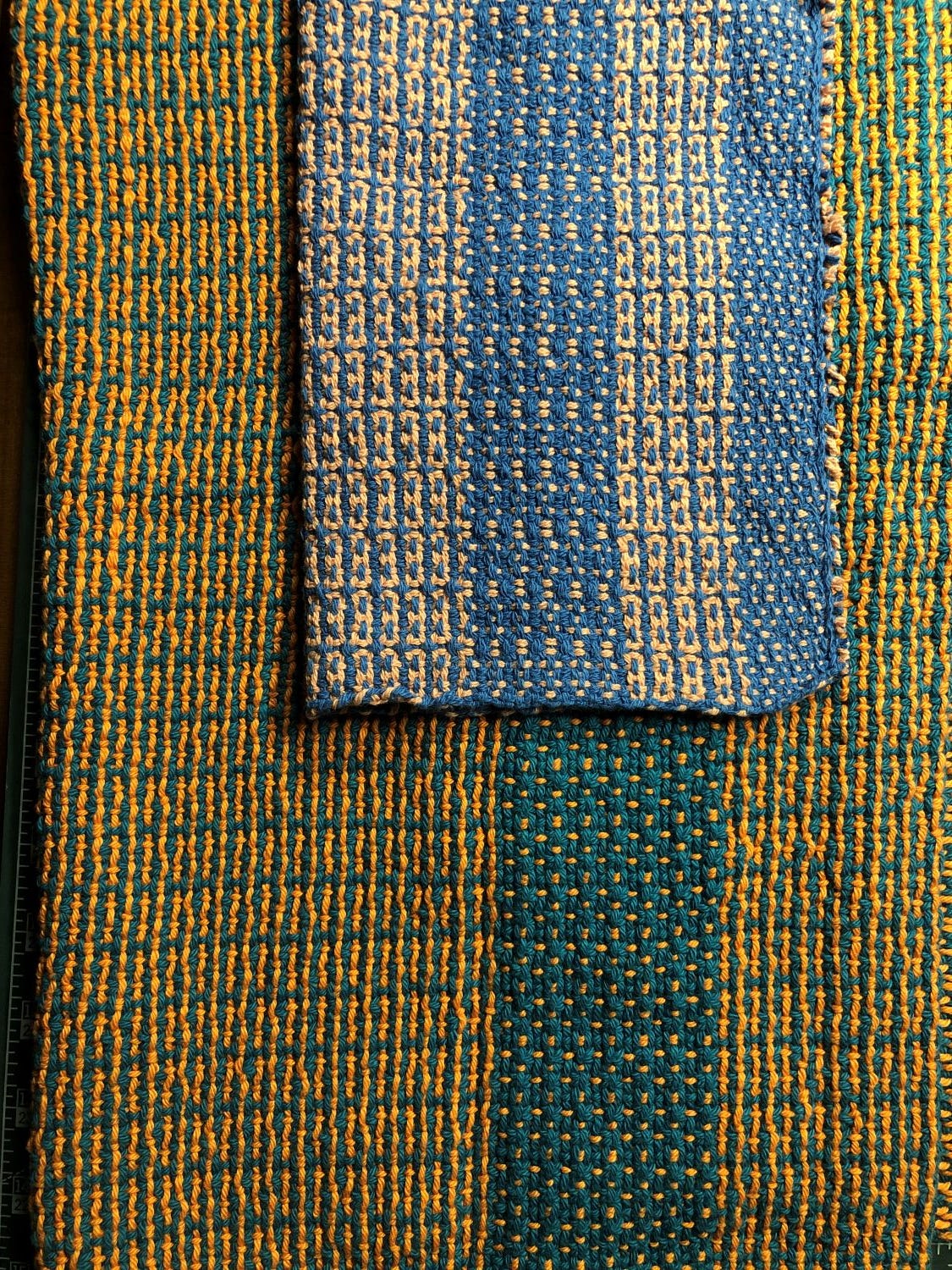
This past January, I wove the same set of twill towels two times. I’ve griped about mentioned these towels before, but they are an object lesson in how 8/4 and doubled 8/2 weave up differently in some cases. The photo above shows the same exact pattern, woven with both yarns. While I really like the intensity of the colors in the 8/4 sample, the doubled 8/2 on top yielded a much crisper image.11 The much rounder 8/4 didn’t behave in the twill pattern in the same way as the more flat doubled 8/2.
Round straws versus flattened ones - sometimes the devil is in the details.
Off to work on finishing touches for the family! Wishing those who celebrate a very Merry Christmas and everyone a Happy New Year and Happy Weaving!
I am truly abysmal about tooting my own horn, even if that’s what is needed at times to get something going. It’s why I am not in your inbox as often as some. Quality over quantity, I hope?
Those responses were so nice to read!
The yards per pound of a fiber is also known as the grist. This yards per pound differs from the Craft Yarn Council’s system, where a smaller number is a finer diameter yarn and a larger number indicates a thicker diameter yarn. Those numbers are solely based upon a yarn’s diameter. This means yarns with a fluffy halo (like mohair), while very fine, can have a higher number and thinner yarns, made of plant-based fibers like sugar cane or banana fiber, can be very heavy for their size.
European Union countries, and others, often list the plies first, then the gauge of the plies, so what we call 8/2 is noted as 2/8 “over there.” Maysville lists their version as 4/8.
Traditional cotton sewing thread is a 50/2, for reference. This also explains why sewing needles have larger numbered sizes as the eye of the needle gets smaller - it corresponds to the size of the thread the eye is designed to take (though the numbers don’t seem to correspond to the gauge in any way, just the scaling from small numbers to larger ones.) All of these numbers have their origins in the Industrial Revolution and the mechanization of thread and needle production, which allows for these levels of precision.
I may revisit this notion, but if I could gift all weavers (and knitter and crocheters) any skill that would compliment and enhance their fiber arts experience, it would be a solid understanding of hand spinning. All of these concepts like grist, ply-strength, etc., would be so much more intuitive if everyone had some understanding of spinning.
“Hand” is a subjective notion, but refers to the stiffness, drape, texture, and feel of a fabric, all of which are influenced by things like materials, means of production (knit or woven, for instance), and the fabric’s suitability for the task for which is it being evaluated, plus the evaluator’s own experience and senses.
I have recently done both - used doubled 8/2 for a towel and DK weight yarn for a scarf (which was used singly). The scarf, though MUCH narrower, was much more mentally intense to warp than the towel.
I was a homeschool mom. Preschool science is the best!
Or, if you really want to do preschool science, try this with actual straws. It’s worth it for the laughs!
This pattern is Techy Towels in Winter 2025 Little Looms.
Glad I asked the question. 😃
Whew!! The pictures are helpful ,for sure...... I learned some things..... Thanks! With my crafting I tend to go with what "looks" best to me...... I'm sure you can't do that so easily with weaving. There's lots to consider! Nice post, Michele.